
Air Duct Cleaning in Amana, IA
When air duct cleaning can't wait in Amana, the shortest path is a contractor who already knows this market — where heating here is engineered against design lows near -8°F and hard freeze winters with sub-zero mornings write the service calendar. This line routes by zip code to an independent IA-licensed pro, states the diagnostic fee before booking, and leaves the hiring decision with you.
Climate figures rounded from NOAA 1991–2020 normals for Cedar Rapids/Davenport, IA; design temperatures are regional planning values. See our methodology.
U.S. Census Bureau, American Community Survey 2023 5-year estimates (tables B25003, B25024, B25035), city-level.
What does Amana do to heating and cooling equipment?
Around Amana, the climate ledger reads 6,400 heating degree days to 900 cooling — a heating-dominated market by any measure. Local design practice plans for 89°F summer peaks and -8°F winter lows, which is why the calls that cannot wait come in winter.
Housing stock matters as much as weather. The typical owner-occupied home in this market dates to around 1965 — call it 61 years of duct settling, envelope drift, and at least one equipment generation already lived and died. Gas furnaces dominate an older housing stock; basements make duct access easy and duct sealing cheap relative to the savings.
Every referral here starts from the zip code: Amana (2 zips) maps to independent contractors who chose this territory and hold Iowa licensing for it. The after-hours line is staffed in this market, so weekend and holiday failures still reach a human with a truck.
Crews covering Amana stage across the same corridor as Iowa City and Ainsworth, which keeps response windows honest. Amana itself is a compact multi-zip market — duct services active across 2 zip codes plus genuine after-hours routing — and market size shapes service reality: how fast a air part gets sourced, and how deep the comparison-bid bench runs.
What are Amana homeowners describing — and what does it mean?
Visible dust puffing from registers when the blower starts
Loose debris in the runs nearest the registers — the clearest legitimate trigger for cleaning.
Just finished a renovation
Drywall and sanding dust in ducts recirculates for months; post-construction cleaning is the industry’s most defensible use case.
Evidence of rodents or insects in the ducts
Droppings and nesting material make cleaning a health measure, paired with sealing the entry points.
Musty smell when air runs, or visible mold at registers
Cleaning helps only after the moisture source is fixed — otherwise it returns.
Moved into a home with unknown duct history
A camera inspection first tells you whether cleaning is warranted at all.
Calling from Amana — what are the four steps?
-
Describe it room by room
Rooms that never condition, dust that returns overnight, whistling registers — the pattern in your Amana house narrows the diagnosis before anyone arrives.
-
The distribution-side pro
Your call reaches a local crew that works the distribution side daily, in a housing stock whose median vintage runs near 1965.
-
Measurement before money
The test comes before the quote: measured leakage, documented condition, then a scope you can compare across bidders.
-
Verified results
The job closes with the same instrument that opened it: before and after numbers, side by side.
How does air duct cleaning pricing work in Amana?
Pricing is set by the independent contractor — never by us — and the ground rules are the same on every call we route: the diagnostic fee is stated on the phone before dispatch, any after-hours premium is named up front, and you receive a written quote you can compare against any other bidder before authorizing work.
That structure isn't generosity — it's how the network stays healthy. A Iowa contractor who surprises homeowners at the doorstep stops receiving routed calls, which means the pros who remain are the ones whose pricing conversations survive daylight. You benefit from that selection every time you dial.
| What to expect | When | Why it matters |
|---|---|---|
| Diagnostic fee disclosed | On the phone, before dispatch | No doorstep surprises — the visit price is known before a truck rolls |
| Findings shown, not described | During the visit | The failed part and its readings, in front of you |
| Written quote | Before any work begins | Yours to keep and shop — comparison is expected here |
| Scope itemized | In the quote | Model numbers and labor scope in writing |
Researching typical national figures first? Read Air Duct Cleaning Cost — and the Coupon Trap — the itemized national breakdown, kept separate from this routing service.
Timing a air duct cleaning call in Amana
Demand for air duct cleaning around Amana is not flat — it spikes with the first hard cold snap, when every marginal system in a 6,400-HDD/900-CDD climate gets stress-tested in the same week. Contractors triage: genuine emergencies first, vulnerable households next, everyone else into a queue measured in days. The same call placed two weeks earlier lands in a calendar measured in hours.
Quotes gathered off-peak also age well: scope written in September can be executed on your schedule, not the weather's. Either way, the calendar is a price lever most homeowners never think to pull.
One more calendar note specific to this market: with a median local home vintage around 1965, whole neighborhoods share equipment generations — and when a cohort ages out, replacement demand spikes together. Homeowners who quote a season ahead of their system's statistical retirement buy from a calm market; the neighbors who wait buy from a rushed one.
Rooms that never work right?
The problem is usually in the ducts, and it is measurable. Book the test that puts a number on it.
Call (877) 565-3062Should you fix the distribution before blaming the equipment?
Airflow and envelope problems masquerade as equipment failures constantly: rooms that never condition, systems that run endlessly, bills that creep with no rate change. The equipment gets blamed because it's visible — but the ducts, the returns, and the insulation above the ceiling decide how much of the equipment's output ever reaches the living space.
This is why measurement-first contractors win here. A leakage test or static-pressure reading turns the invisible half of the system into numbers, the scope gets written against those numbers, and the after-measurement proves the fix. Distribution work done this way routinely outperforms an equipment upgrade on comfort per dollar — and it makes any future equipment purchase smaller.
Which guides might save this Amana service call?
- Home Ventilation: Why Tight Houses Feel Stuffy and How to Fix It — Stuffy rooms, window condensation, lingering odors — signs your house needs deliberate fresh air. Exhaust, intakes, and ERV/HRV options compared.
Before the truck reaches your Amana address
Techs solve faster with context. The five minutes before a Amana visit that pay for themselves:
- Your equipment labels: a phone photo of the data plate on the unit gives the contractor model and age before arrival.
- Any past paperwork: prior repair invoices or tune-up sheets turn guesswork into history.
- The electrical panel location — and whether any breaker has tripped during the failure.
- The filter situation: when it was last changed and its size — the answer redirects a surprising number of diagnoses.
- The symptom timeline: when it started, whether it comes and goes, and what (if anything) changed in the house right before.
- Pets secured and gate codes shared: the two most common arrival delays, both free to prevent.
Which terms will your Amana contractor use on this job?
Indoor Air Quality (IAQ)
Indoor air quality (IAQ) describes the healthfulness of air inside a building: particle levels (dust, smoke, allergens), humidity, and gas concentrations (CO, VOCs, radon). HVAC shapes IAQ through filtration, ventilation, and humidity control — the blower and ducts determine what circulates, and how often air turns over.
Ductwork
Ductwork is the network of channels that distributes conditioned air: supply ducts carry heated or cooled air from the equipment to the rooms, and return ducts bring room air back to be filtered and conditioned again. Materials range from rigid sheet metal to insulated flexible duct, joined at a main trunk or plenum.
Plenum
A plenum is the sheet-metal distribution box that connects HVAC equipment to the duct system. The supply plenum sits on the equipment’s outlet, receiving all conditioned air before it branches into individual ducts; the return plenum collects incoming air just before the filter and blower. The AC’s indoor coil typically lives inside or atop the supply plenum.
Fresh air intake
A fresh air intake is a duct that deliberately admits outdoor air into the HVAC system’s return side, so the blower mixes fresh air into circulation each cycle. Usually fitted with a damper — manual, motorized, or controller-run — it is the simplest form of whole-house mechanical ventilation, and modern residential codes commonly require some version of it.
Every term links to its full glossary entry — the practical homeowner angle included. All 50 terms →
How to verify the pro who shows up
Every contractor in this network is an independent Iowa business responsible for its own licensing, insurance, and workmanship — and every legitimate pro expects to be verified. The checks below take five minutes and filter out nearly every bad outcome in residential HVAC:
- Get the diagnostic fee and its terms (does it credit toward the repair?) stated before the visit is booked.
- Check the labor warranty in writing — 1–2 years on repairs is standard; "we stand behind our work" is not a term.
- Ask for the certificate of insurance — liability and workers’ comp. A pro emails it in minutes; hesitation is the answer.
- For quotes: model numbers, written scope, and permit handling in the document — a one-line quote is a red flag stated politely.
- Confirm the license: ask for the number and check it against Iowa's contractor licensing authority before work begins.
None of this is adversarial — it's how good contractors prefer to work. A Iowa pro who quotes fees on the phone, shows the failed part, and writes scope you can shop has nothing to fear from a checklist; the visit simply goes faster with an informed homeowner on the other side of it. The rare contractor who bristles at verification has answered the most important question before any work began.
Amana air duct cleaning: the short answers
What separates real duct cleaning from the too-cheap coupon offer?
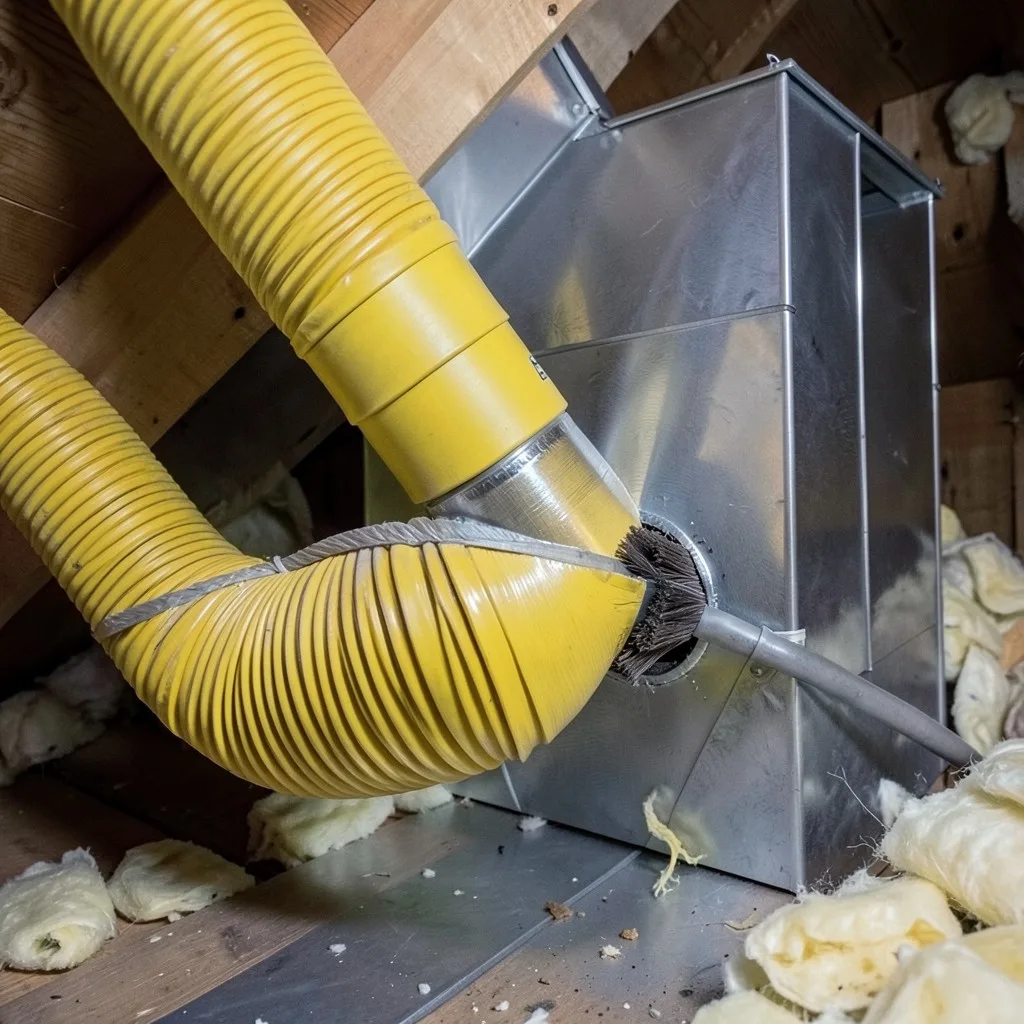
Method. Legitimate source-removal cleaning puts the entire duct system under negative pressure with a HEPA collection unit, then agitates every run with rotary brushes or air whips so dislodged debris travels to the collector — 3–5 hours for a typical home. The coupon version vacuums a few feet into each register in 45 minutes, then upsells mold treatment. Ask about negative pressure and NADCA standards; the answer is diagnostic.
How often do ducts need cleaning?
There is no legitimate fixed interval. Trigger-based is the defensible answer: after major renovation, after pest intrusion, when dust visibly discharges, when mold is confirmed. A tight, well-filtered duct system can go a decade or more without needing it. Anyone selling annual duct cleaning as standard practice is selling recurring revenue.
Will cleaning ducts fix my allergies or dust problem?
Only if the ducts are genuinely the source, which is less common than the marketing implies. Most household dust originates in the living space. The higher-leverage sequence: better filtration (MERV 11–13 if the blower can handle it), duct sealing so the return side stops inhaling attic and crawlspace air, then cleaning if inspection shows real accumulation. Cleaning dirty ducts while leaving them leaky treats the symptom.
Should ducts be sanitized or fogged after cleaning?
Routine chemical fogging is upsell, not science — the EPA does not endorse routine biocide use in ducts, and aerosolizing chemicals into your airstream has its own downsides. Where mold was physically removed, fixing the moisture source matters more than any spray. A contractor who leads with "sanitizing" before showing you contamination is running a script.
How cold does it get in Amana, and what does that mean for heating?
Heating systems here are designed against winter lows near -8°F, across roughly 6,400 heating degree days a year. Hard freeze winters with sub-zero mornings means a genuine no-heat failure is a same-day problem — and in freezing stretches, a pipe-protection problem too.
Does the age of Amana housing change what goes wrong?
Meaningfully. With a median build year around 1965, much of the local stock is on its second or third equipment generation while running original ductwork. Gas furnaces dominate an older housing stock; basements make duct access easy and duct sealing cheap relative to the savings.
Does weather here really change what air duct cleaning costs?
Indirectly but reliably. With 6,400 heating and 900 cooling degree days a year, local failures cluster around first-stress weather — and when every truck in Amana is booked, after-hours premiums and multi-day queues do the pricing. The same job in shoulder season books same-day at standard rates.
Who actually shows up when I call?
An independent, third-party contractor whose registered service area covers your IA zip code — not an out-of-market call center crew. We are a referral service: the contractor sets pricing, runs the visit, and answers for the work, and you owe nothing for the connection itself.
Prefer a callback from a Amana pro?
Same zip-matched routing as the phone line — an independent Iowa contractor calls you, fee quoted before any visit.